

As a foresight professional, I have opened many a futures project or session, saying something like this: “The future is not a destination; it’s a journey in which we all shape the future.”
But the reality is this. We have an unnamed, wilfully ignored, almost embarrassing pattern in foresight work: no matter how far we try to project outward, the futures we generate [arrive at] tend to look suspiciously alike. We use different headlines but hold on to the same underlying scaffolding. Different technologies arise, but same assumptions apply. We sketch branching maps of possibility, yet somehow all the branches bend back toward the same path.
We launch frameworks, name trends and coin terminology in an ever-breathless race to the front; to the jobs, the stages of influence, the ‘expert’ titles. The category of the future is packed full of bodies and offers to create ‘desired futures’ for the diminishing group of potential clients. [I say diminishing, simply because with AI, everyone is now a futurist, and the incentive to hire actual foresight professionals is evaporating – until somebody invariably will realise that what a futurist can do, does not reside inside an LLM. But that’s another story.]
Anyway, this is not a bitter venomy rant against my profession. The field has never been more abundant of people with energy, passion and something to say. It is not a failure of creativity either. The challenge is structural and closer to the idea of path dependency.
So…
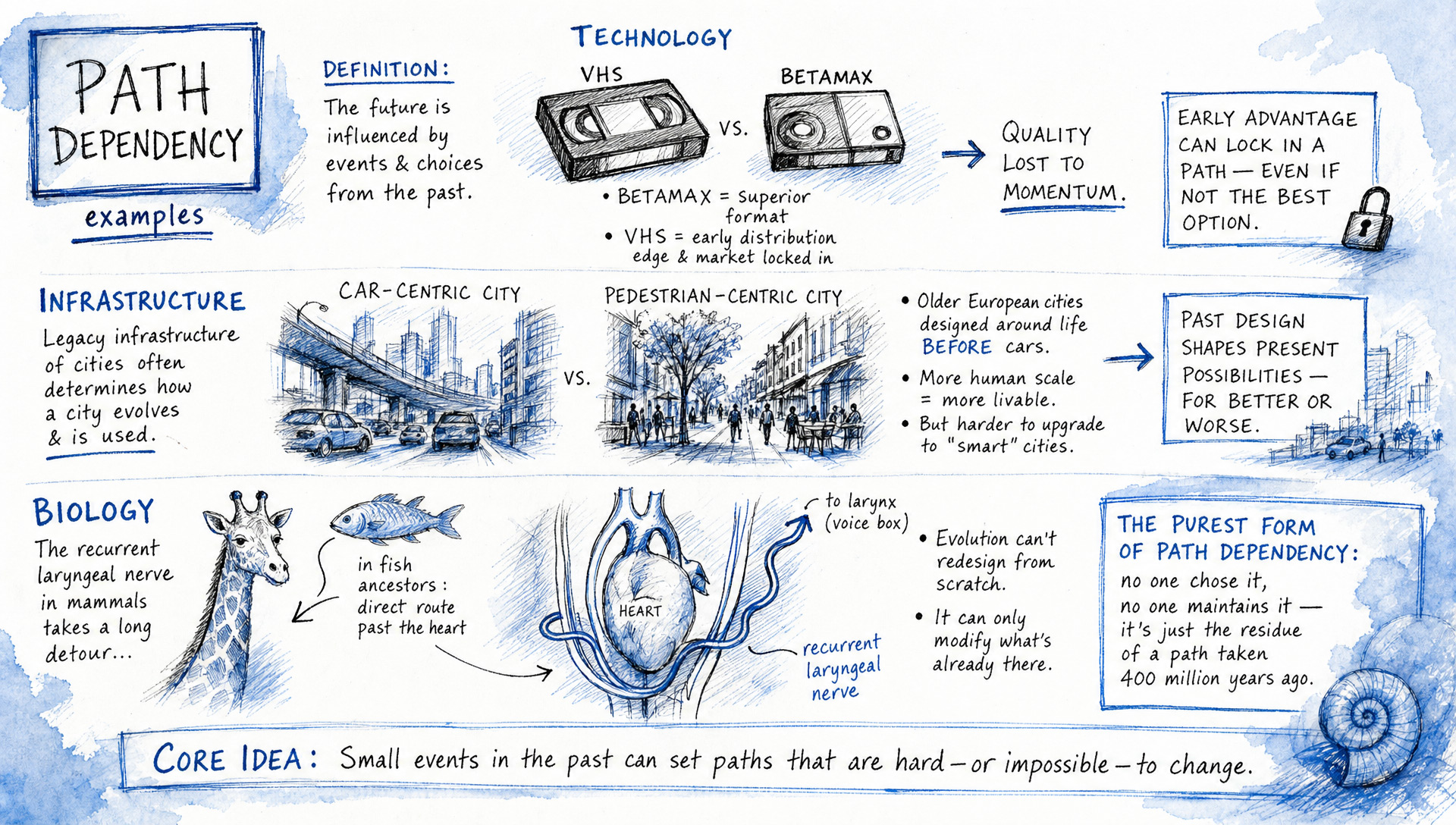
Path dependency tells us that what seems like an open field is, in practice, a narrow corridor shaped by decisions already made. And this is not just about technological decisions [though that is a big part of it]. It is also about cultural defaults, institutional habits, aesthetic norms, and inherited metaphors. Once we take a step down a path, it becomes easier to stay on it than to leave it. And when we go down the path, infrastructure and language begin to ossify. Desirable futures become formatted and when that happens the future is no longer a horizon but an emoji bullet point in a LinkedIn post.
Comforting Fictions
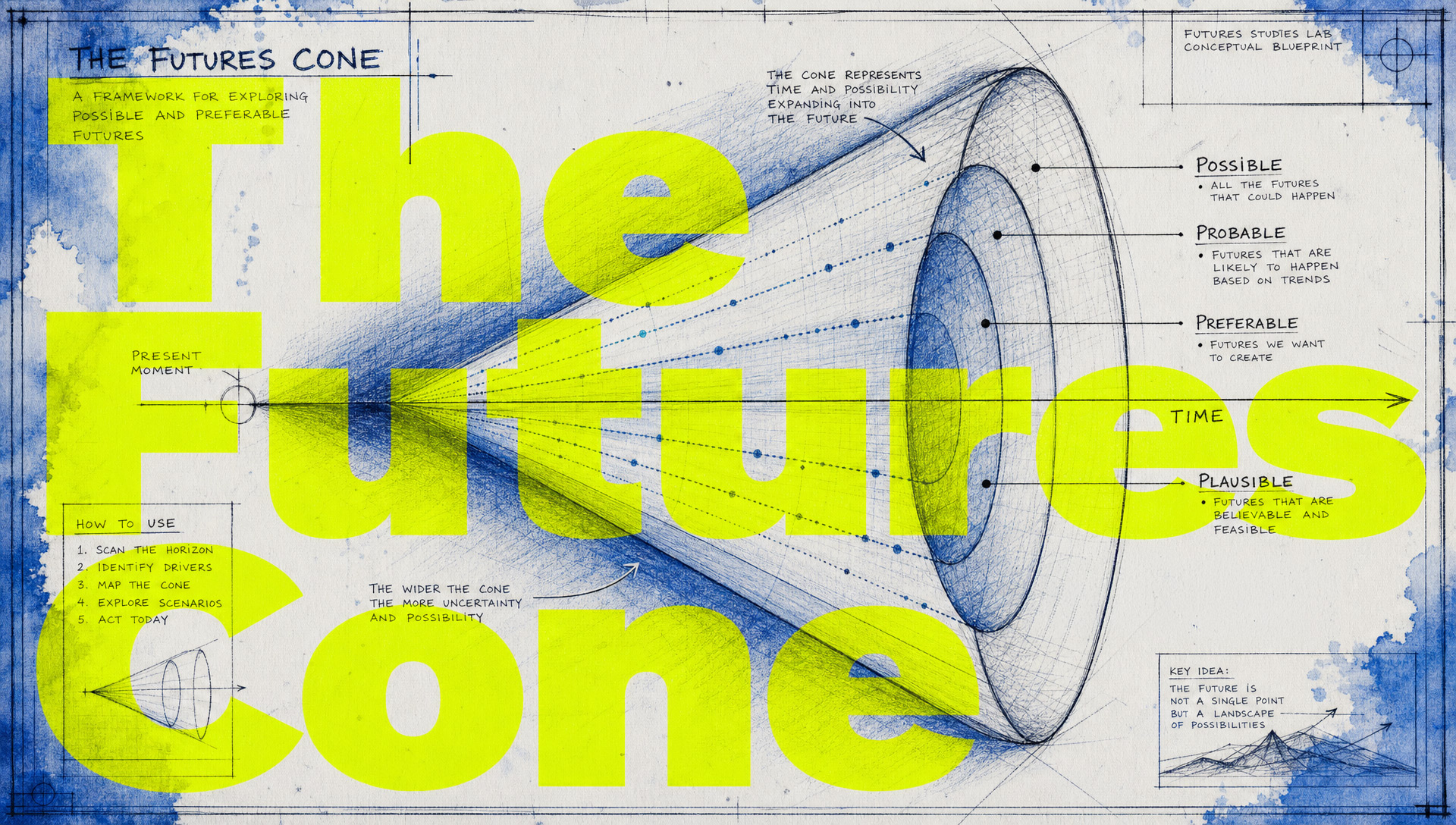
The futures cone. Oh yes, I see all my fellow foresight colleagues nod in recognition, is a widely used foresight framework. It offers a clean geometry of possibility: probable futures, plausible futures, possible futures, and the preferable. This is a model that not only suggest, but promise expansion, divergence, openness. But often, in practice, the cone behaves less like exploring difference and potentiality and more like a funnel of repetition.
Why?
Because the cone assumes that imagination scales linearly with uncertainty and if we extend our thinking further outward, we will in organic and natural ways access more radical alternatives. But imagination does not work like that. You do not necessarily become more imaginative just by removing yourself outwards from the core. To imagine radical futures, we need to see a rupture of the cone itself. Otherwise, we risk the model simply stretches the ‘business as usual’ scenario into thinner and thinner versions of itself.
This is why so many “futures” feel interchangeable. Even our dystopias are conservative. And the reverse is true too. Note how the beautiful scenarios of thriving societies in Solar Punk rarely asks deeper questions such as ‘how or why’ all people would suddenly share same values and outlook.
The reason why we are bad at imagining the future is that we suck at escaping,
not just ourselves, but also the present.
Why narrative Lock-In is seductive and disruption is so exhausting
I get it. I have been sitting in many workshops and client meetings and there are simply no one who gives a fuck about this. ‘Path dependency’ is easy, we can plan and we can create the ‘desired futures’ within this existing frame. Even the ‘less desirable’ futures offered along the path, can be put into language and strategized for. Disruption is exhausting, it might end in disaster and will certainly upend or rewrite existing systems. It does not promise success, only change.
Path dependency is not just stabilising in economic and social terms. It governs what feels believable, what feels serious, what feels “realistic.” Entire futures are thus discarded and not because they really are impossible, but because they violate the tone of plausibility. This is the reality we work in; the future must resemble something we already recognise. But will it lead to desirable futures? I’m not so sure. Are we ‘actively shaping the future’ in a desirable way, as we set out to do, or are we just happy we get to pay rent next month too.
Do we question who benefits form the narrative lock-in? Of course, most of my fellow foresight peeps do. And thankfully many others are beginning to, too. Take AI, with its unescapable and blatant narrative of inevitability. This to me smells suspiciously like engineered path dependency. A simple ‘follow the money’ will tell us who really benefit from having this particular narrative dominate the conversation about the future. But pervasive AI is not an inevitable future. And between you and me, AI can’t deliver the change they herald either – which in my book is a good thing. Except, the narrative has already taken us all too far. So many governments, institutions, businesses, organisations and people have put their bet on AI. Crazy amounts of money have been poured into the biggest AI companies’ systems of convoluted investment and roundabout financing. If those systems collapse; if they fail and we see that the emperor is naked; then that will very possibly cause a financial crisis bigger than we have seen before. It will certainly cause rupture. And it will certainly not be *a* desired future, but it might just be the possible escape from the current path. But at what cost? It won’t be the tech-bros paying, that is for sure. When have they ever been held responsible for fucking things up? It will be ordinary people paying. Of course it will. The best one can hope for here, is that the Overton Window, which will be opened by the rupture, will allow us to make a meaningful leap to a different path. To a trajectory that will be better for all. Hopefully we will seize the opportunity to set right, the ecological kamikaze path we are on too, while we are at it. Hope is a beautiful thing, but it will take real work to shift us to another path.
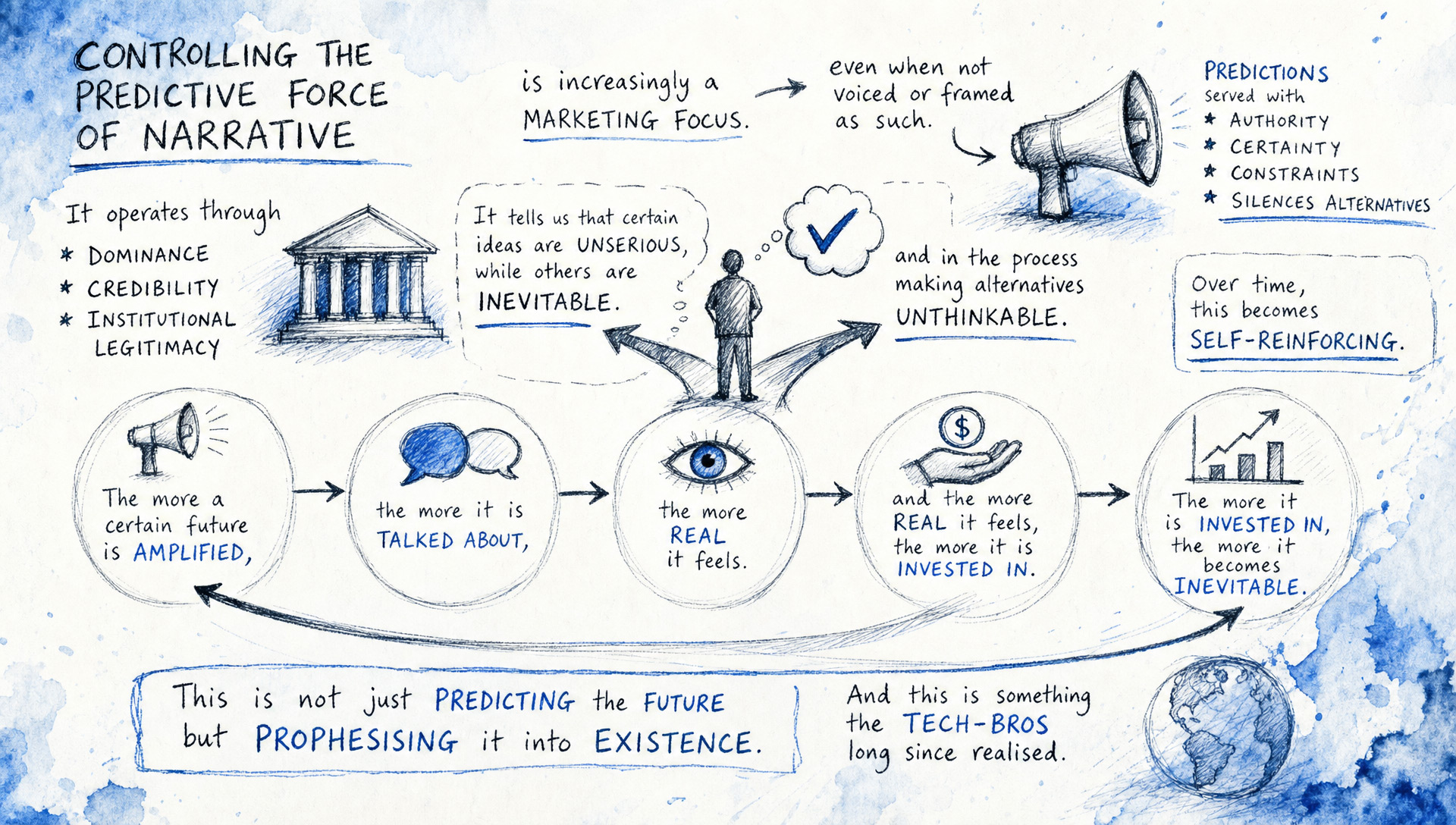
Controlling the predictive force of narrative is increasingly a marketing focus, even when not voiced or framed as such. Predictions served with authority and certainty, constraints and silences alternatives. It operates through dominance and institutional legitimacy. It tells us that certain ideas are unserious, while others are inevitable, and in the process making alternatives unthinkable. Over time, this becomes self-reinforcing. The more a certain future is amplified, the more it is talked about, the more real it feels. And the more real it feels, the more it is invested in. The more it is invested in, the more it becomes inevitable.
This is approach is not about just predicting the future but actively prophesising it into existence. And this is something the tech-bros have long since realised.
Why All Futures Start to Look the Same
There are at least three overlapping mechanisms at work:
1. Cognitive Inertia
We extrapolate from what we know. Even when we attempt to be radical, we remix familiar components. The unknown is built out of the known. (so far, so LLM’ish)2. Institutional Gravity
Organisations fund futures that align with their current trajectories. Radical alternatives rarely survive budget cycles.3. Cultural Feedback Loops
Media, design, and discourse circulate the same visions repeatedly. The future becomes a genre with established tropes.
Together, these produce a narrowing effect, through a lack of perceived options.
But is this so bad really?
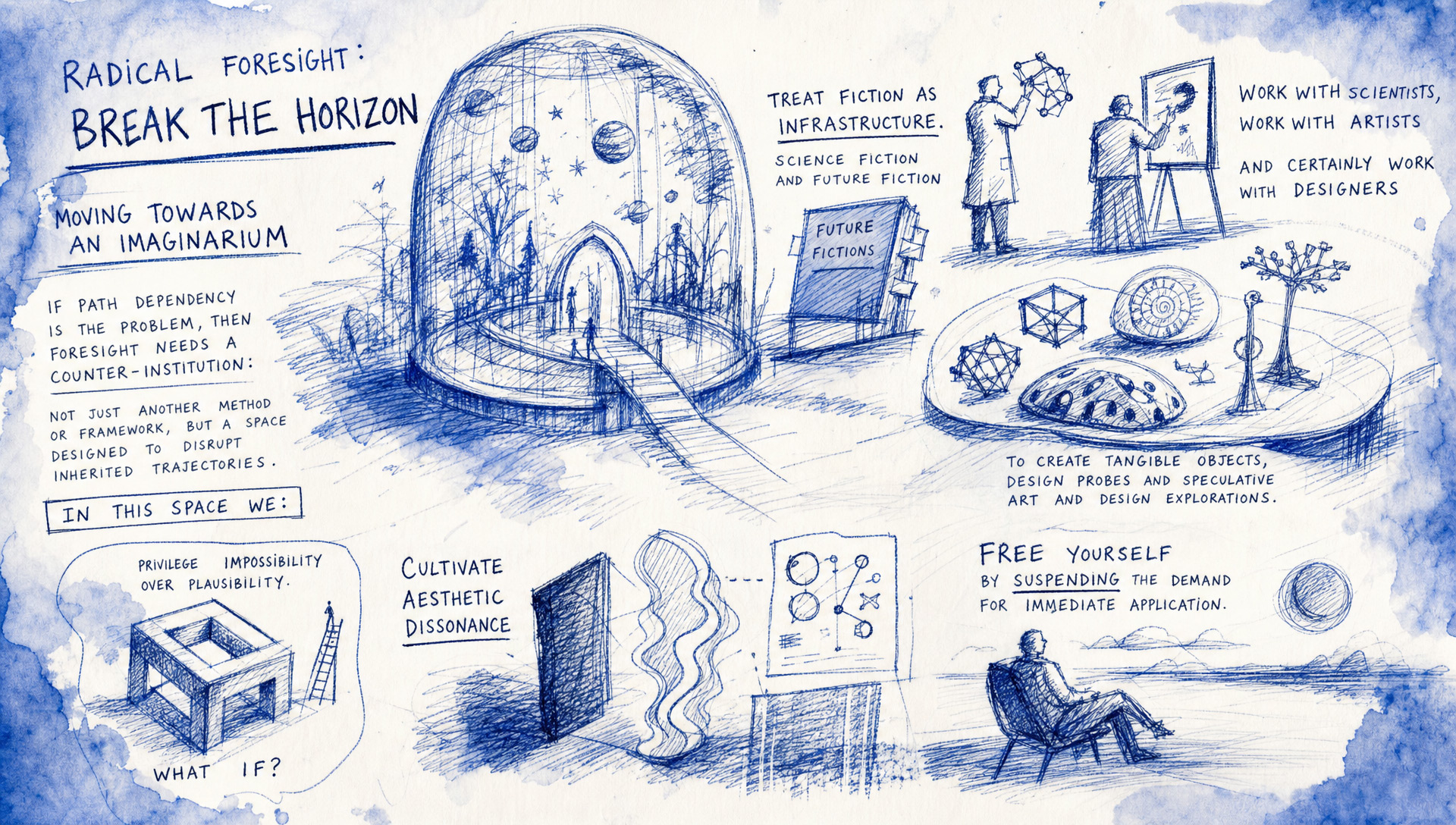
Radical foresight: Break the horizon: towards an Imaginarium
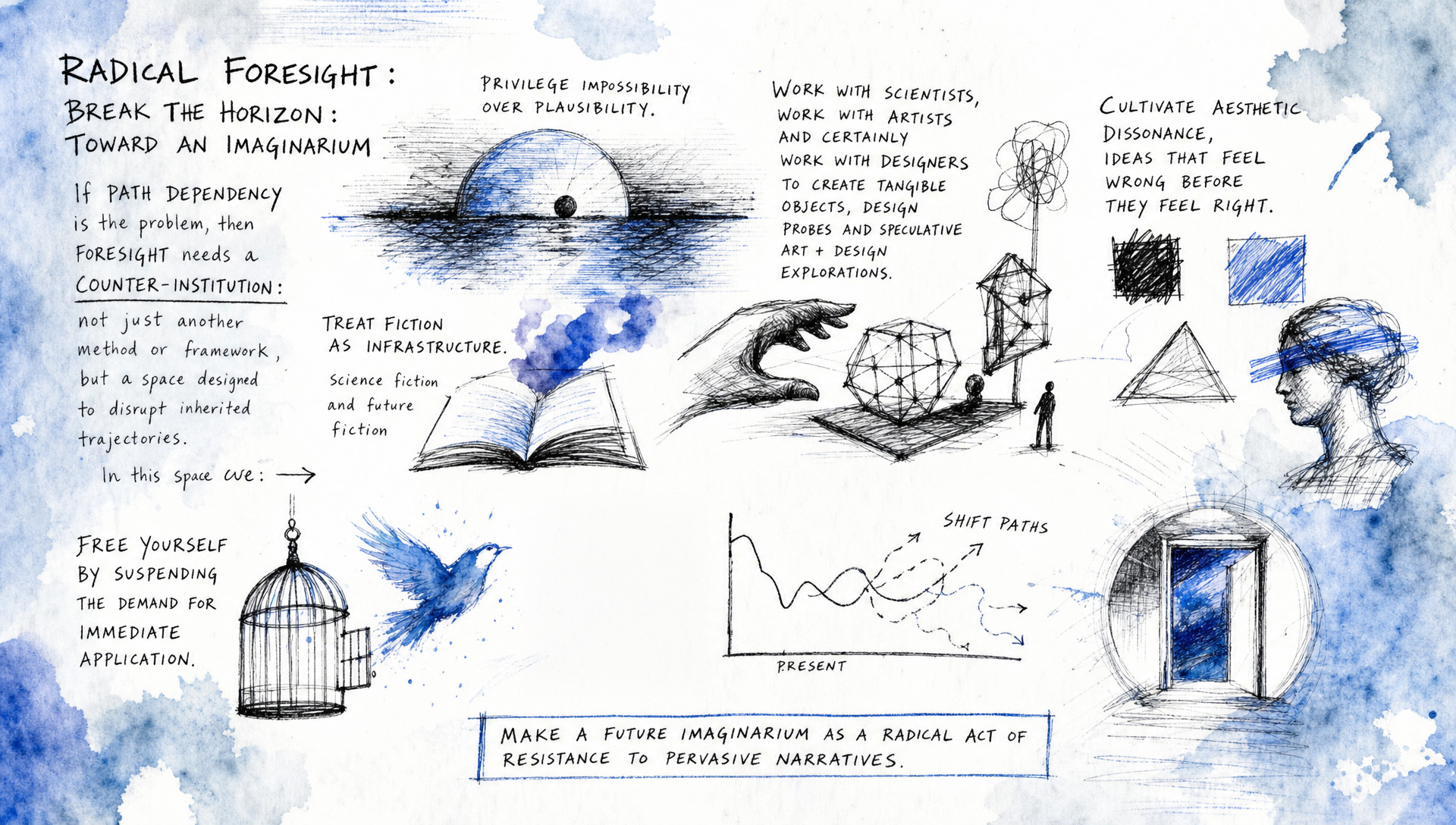
If path dependency is the problem, then foresight needs a counter-institution: not just another method or framework, but a space designed to disrupt inherited trajectories. In this space we:
· Privilege impossibility over plausibility.
· Treat fiction as infrastructure, science fiction and future fiction
· Work with scientists, work with artists and certainly work with designers
· Move into tangible space and objects; design probes and speculative art and design explorations.
· Cultivate aesthetic dissonance, it is okay if it feels wrong before it feels right.
· Free yourself by suspending the demand for immediate application.
Make it a goal not to ‘predict’ the future but to destabilize the present enough to shift paths. Make a future Imaginarium as a radical act of resistance to pervasive narratives.
The Role of Speculation (and Its Limits)
Speculation is often framed as liberation, in fact, I just did myself. But speculation without critique risks becoming another layer of path dependency. It can easily reproduce dominant assumptions in more elaborate forms.
The challenge, then, is not just to speculate but also to interrogate the conditions of speculation itself.
· Who gets to imagine? And why?
· What frameworks are they using?
· What remains outside the frame?· What remains unsaid?
and not least
· What are the stakes?
So, a speculative foresight practice would not just generate alternative futures, but would also expose the mechanisms that make certain futures thinkable in the first place.
The road not taken – choice is a birch
These anti-futures are meant to act as a violent destabilizer to our future sense. A way to shock, hack or to pry open the space of imagination.
Because paradoxically, by abandoning the goal of usable [read commodifiable] futures, we may recover the ability to imagine truly different ones.
Moving Beyond the Locked Narrative is less about generating better ideas and more about altering the conditions under which ideas emerge.
Some possible interventions:
· Temporal Displacement
Instead of projecting forward, project sideways. Imagine parallel presents rather than linear futures.· Narrative Sabotage
Take dominant future narratives and deliberately break their internal logic.· Aesthetic Drift
Introduce unfamiliar visual, linguistic, and conceptual elements that disrupt recognition.· Institutional Friction
Create structures that reward divergence rather than alignment.· Curated Weirdness
Systematically expose foresight processes to ideas from outside their usual domains—art, fringe theory, speculative fiction, subcultures.
These are not proposed solutions in the traditional sense but possible tactics for loosening the grip of the present. Because the future will look different the moment, we stop asking it to make sense.
But why would we even do this? Is it our business as foresight professionals to actively try to influence the future trajectories.
No, not necessarily, unless you are an aspiring revolutionary.
This type of foresight is certainly not for all. But we owe it to ourselves and to the future to at least imagine and consider real alternatives to the paths taken. Not alone. That is not the job. But together. Gather round and dream out loud. And make sure to talk about the monsters hidden in the unknowns but also what is on the other side. Then we can all go back and nudge towards the desirable futures inside the cone.
Studio Loecke
Get in touch for a coffee and an chat. We can help you translate knowledge about the future, people, markets and trends into creating marketing, communication and branding strategies. Or perhaps you want to know more about our courses in Foresight and AI for creative and marketing.