
After the pandemic, everything with the faintest touch of analysis or foresight was framed as ‘the new normal’ or the ‘next normal’. Those phrases now feel quaint. Museum labels affixed to exhibits that collapse while we were still admiring them. For a while we have been living in the accelerated state of what Alvin Toffler called ‘Future Shock’. Not just shock because the future ‘is arriving’ before we are ready, but the disoriented state of experiencing too much change in too short a time. Technological, social, and cultural shifts that make it hard to adapt. Rushkoff went one up in ‘Present Shock’, arguing that we are now in a state of narrative collapse, living in a perpetual now, which means that there is no future at all.
So, what to do?
Today is Wednesday, the time is 10.15 CET, in this post normal world, where trust has not merely declined but is collapsing in real time. Governments lie openly and incoherently. Experts contradict one another, and peer reviews are designed for citations over ‘scientific truths.’ News is less a mirror of reality than a hall of algorithmic funhouse reflections. Diplomacy has shed its rituals and adopted the aesthetics of provocation, trolling, and spectacle. The game board resets daily, sometimes hourly, leaving everyone who is still simply trying to get through the day like an ordinary human being – dizzy and worn thin.
VUCA is the acronym for volatility, uncertainty, complexity, ambiguity, which originated as a framework to prepare leaders for instability. But in a post-normal world, VUCA reads like a corporate mindfulness exercise. What we live now is not manageable turbulence but relentless ontological churn. In this environment, where strongmen govern by vibe and where billionaires and founders rule by platform, a heretical question emerges from the ranks of futurists:
Is foresight still possible? Or has it become a relic of a world that believed in continuity, causality, dialogue, and good faith?
A Case Against Foresight: When the Map Is the Delusion
-
A relatively stable reality at the core, with most variables at the fringes.
-
Actors who behave in semi-rational, legible ways. There are rules which are observed across domains, from business to international laws, such as those regarding diplomacy, war, human rights, etc.
-
Futures that unfold via discernible vectors and trajectories.
What happens when none of these assumptions hold up anymore? When the world resembles ‘liquid modernity’ on steroids? Views, values, behaviours, or power no longer consolidate. Authority migrates between states, platforms, influencers, markets, and memes. Bruno Latour suggested, we are no longer living in a shared “nature” built on common facts. Instead, we live in ‘competing realities’, each sustained by its own infrastructures of belief.
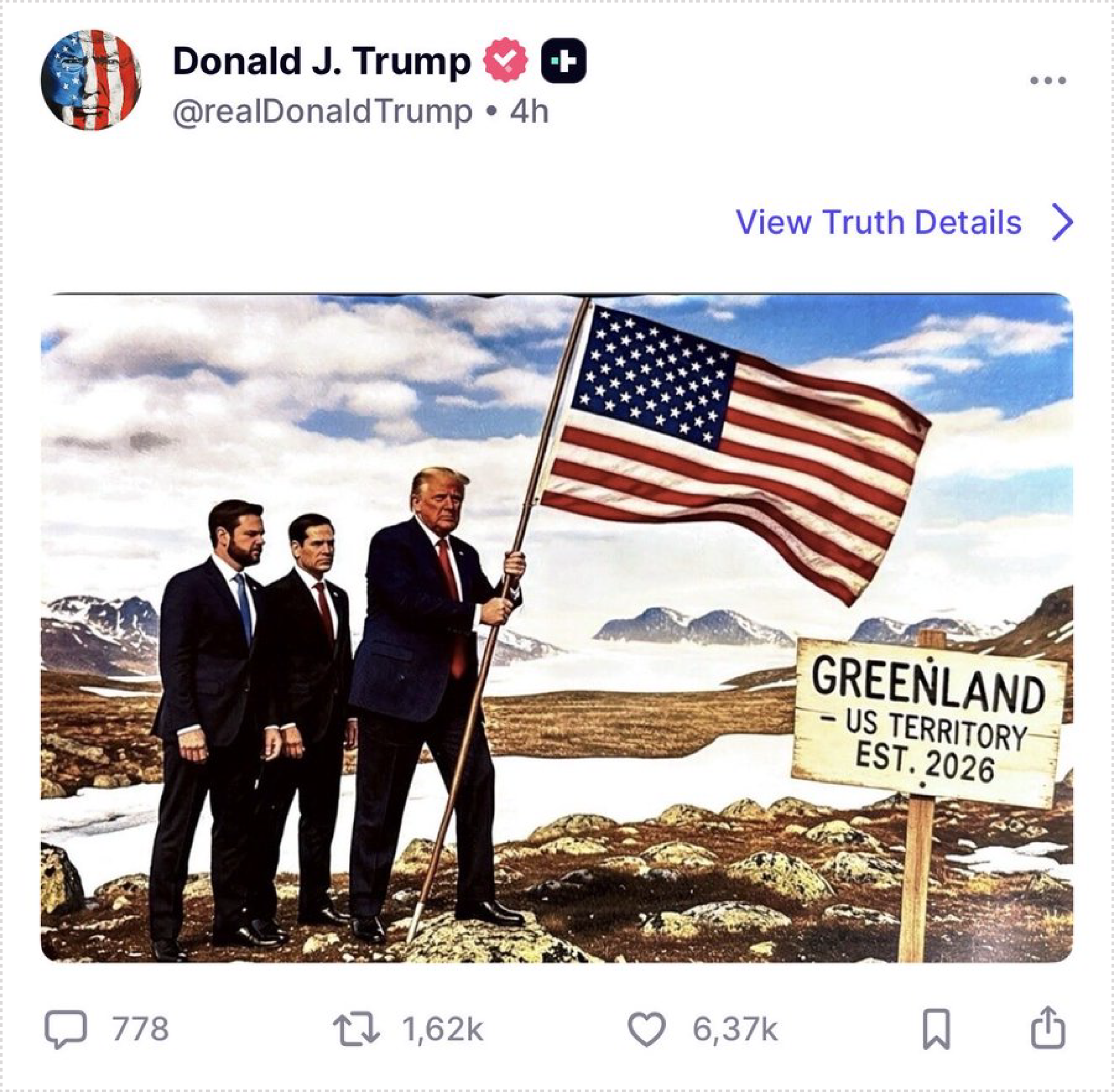
Image: no words needed here, I think
In such conditions, foresight risks becoming ‘narrative laundering’, with foresight professionals becoming producers of compelling stories to scaffold beliefs rather than (admit to) and confront chaos. Scenarios become vibes. Horizon scanning becomes aesthetic curation. Strategy decks function as anxiety management tools for those who sense their control slipping.
Perhaps even worse, foresight can unintentionally reinforce the systems it claims to critique. By assuming continuity, we may uphold what Mark Fisher called ‘capitalist realism’: the idea that while everything feels unstable, the underlying order remains unchallengeable. We imagine futures of AI governance, climate adaptation, and hybrid warfare, but rarely futures where the basic rules of legitimacy collapse entirely.
Black swans no longer arrive from the margins, they are deliberately bred at the centre. The improbable is industrialised and institutionalised, and the abnormal is, well, the new normal. In this landscape, foresight is less like navigation and more like mythmaking. Narratives to prop up those who are ready believers.
The Case for Foresight
– abandoning foresight altogether may be the greater mistake.
The original sin of foresight was never uncertainty; it was hubris. The belief that the future could be shaped through forecasting rather than ‘inhabited’. This is not to strip people of a sense of autonomy. After all, the agency I have worked with for over two decades has the motto: ‘The Future is not somewhere we go, we create the future’. Today, some variety of that statement seems to be everywhere in foresight, and I watch with wonder how wide-eyed and very sincere futurists talk about how they can create ‘a desired future’ (more about this in another post). But, stripped of that illusion, foresight becomes not a tool for control, but a practice of ‘orientation’.
The current disorientating melange of signals in the ‘everything, everywhere, all at once’ will not fit neatly into models and frameworks but is carried by the capacity to make meaning under conditions of plurality. Not that we should abandon the tools of our trade, but they need revision, and we need to not sell them as a ‘fix to the future’. Then, just maybe, they can provide guidance. In a fractured epistemic landscape, foresight’s value lies in creating coherence and revealing underlying tensions. But it means admitting to uncertainty, abandoning absolutism, and claims of accuracy. Today the future really is dark. Not in the sense that it is perpetually bleak but in the sense that we can’t see it. And maybe that is a good thing.
“The future is dark, which is the best thing the future can be, I think.”
– Virginia Woolf, January 18, 1915

Image: yes it is AI – made with midjourney
Yet the Post Normality is not random. It is still offering patterns, even when it looks like potentialities flipping in and out of existence, much like the cast of a Schrödinger’s cat experiment. Still, it is possible to discern patterns of meaning even when they read like structural contradictions. Think:
– The erosion of institutional trust mirrored by the rise of charismatic authority and parasocial power.
– Technological acceleration coinciding with cultural nostalgia and reactionary mythmaking.
– Radical uncertainty producing both nihilism and hyper-moralism, often in the same actors.
In forecasting, it has always been a case of pulling at one thread and finding it is attached to a myriad of others. But how do you orient yourself in a multidimensional space where connecting nodes that used to be somewhat stable now rearrange themselves at seemingly random and create new connections in real time?
Donna Haraway has urged us to “stay with the trouble” – to resist both technocratic solutionism and apocalyptic surrender. And ‘everything, everywhere, all at once’ foresight has a similar aim of embracing the ‘trouble’. It resists the narratives of the unavoidable, the passed-down truths. It does not promise clarity, but it ‘cultivates literacy’: the ability to read signals, spot tensions, detect undercurrents, and meaningful shifts that precede material change. In this mode, foresight practitioners are chaos navigators with a sideline of psychoanalysis for systems.
From Futures to Fictions and Back Again
One of the paradoxes of our times is that fiction has become more reliable than fact. Conspiracy theories, startup pitches, national myths, and internet shitposts all function as speculative narratives. Attempts to impose meaning on a world that feels ungovernable. The line between analysis and imagination collapses. Power increasingly belongs to those who can tell the most compelling story fast enough to go viral.
Foresight, then, must learn from fiction without surrendering to it. Perhaps we should ask:
– Which futures are being emotionally rehearsed right now?
– Which anxieties are being displaced into culture wars, tech panics, or nostalgia loops?
– Which imaginaries are becoming default, not because they are true, but because they are comforting?
The future arrives first as a story we tell ourselves.
What’s next: Foresight as antibody
Not dashboards. Not five-year roadmaps. And certainly not confidence.
Instead:
– Plural futures, held simultaneously, without premature synthesis.
– Reflexivity, acknowledging the forecaster as part of the system they analyse.
– Ethical imagination, leading to long-term [sustainable] vision, not just strategic optionality.
Temporal humility, accepting that some futures cannot be seen but they can sometimes be felt approaching.
Antonio Gramsci is often quoted – across the political and cultural spectrum – to have said, “The old world is dying, and the new world struggles to be born: now is the time of monsters.” Never mind he originally said, ‘morbid symptoms’, not monsters. Either way, the monsters are not anomalies but signals. They reveal what no longer works.
“The old world is dying, and the new world struggles to be born: In this interregnum a great variety of morbid symptoms appear.”
– Antonio Gramsci
We may not be able to tame the ‘monsters’ as foresight practitioners, but we can learn to read them. Foresight will not restore trust, stabilise geopolitics, or make experts credible again. But we can help in a subtle yet radical way, by preventing total epistemic collapse. Foresight can help us notice when we are mistaking noise for significance, novelty for material change, acceleration for progress, cynicism for intelligence.
Then, just maybe, we can help shine a light on paths where we collectively ‘shush away’ the worst ‘monsters’ and help new ideas for better futures into being.
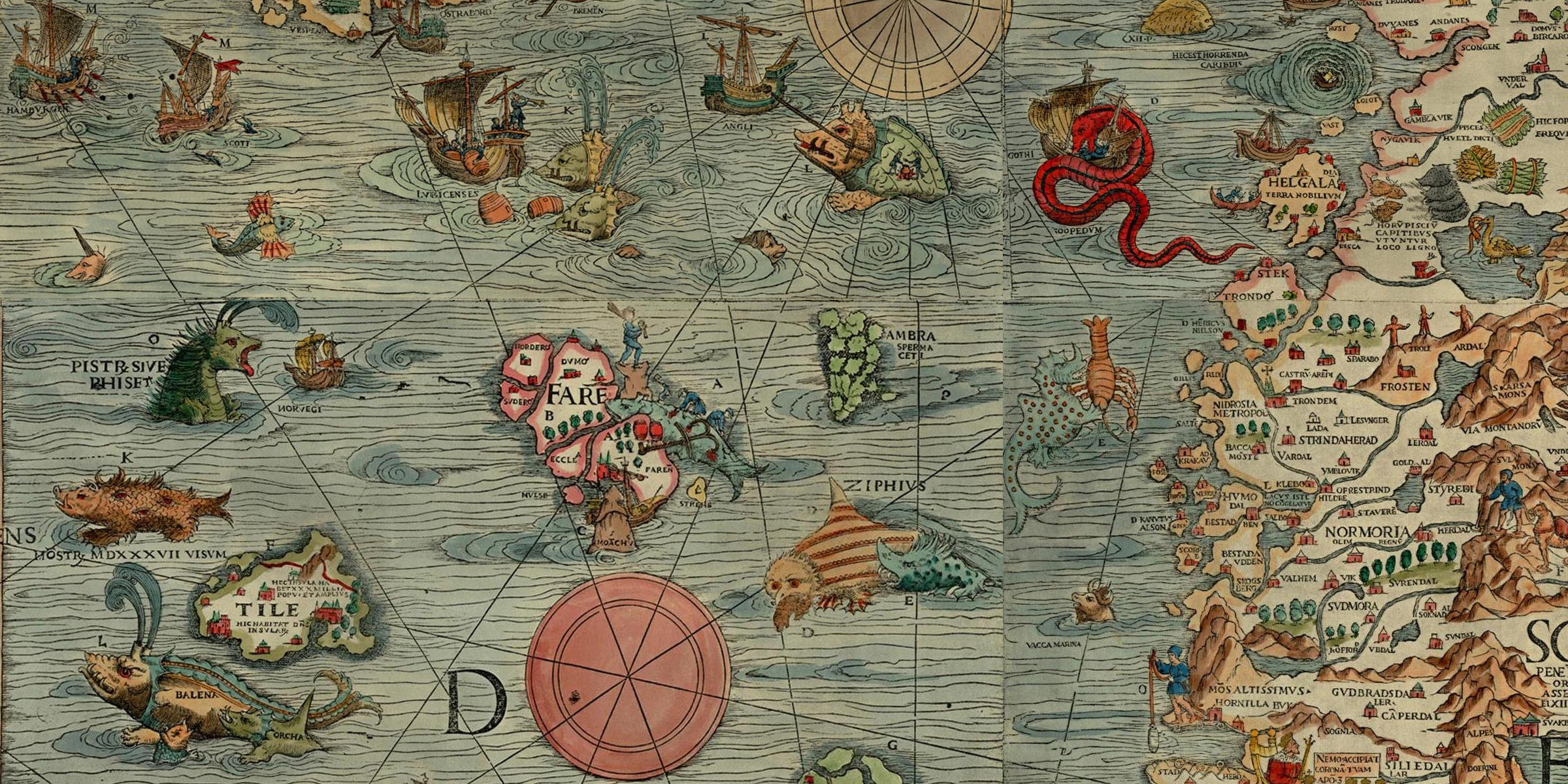
Image: part of the Carta Marina, 1539 – in old maps uncharted waters was often shown as full of monsters, just as much feeding the imagination and sense of adventure as much as the fear of the unknown.
Post Normal
Let’s not mistake the post normal for a phase. It is a condition.
But the future is still dark in the sense that it is open and contested. And so, the ability to think rigorously about what that future could be and why we fear or desire it is not obsolete.
It is an act of insurgence, of civic duty almost… and certainly a neccessity.
Studio Loecke
Get in touch for a coffee and an chat. We can help you translate knowledge about the future, people, markets and trends into creating marketing, communication and branding strategies. Or perhaps you want to know more about our courses in Foresight and AI for creative and marketing.